Mon–Sat: 9:00 AM – 7:00 PM India
+91 9958971235 | Follow:
CretePro

Crystalline Waterproofing vs. Membrane Waterproofing: Which Is Better for Below-Grade Concrete?

Basement leaks don’t show up on day one. They show up two monsoons later, after the finishing work is done and nobody wants to dig back in.

That’s why the waterproofing decision matters so much for below-grade concrete. Get it wrong, and you’re not just fixing dampness. You’re potentially cutting into finished floors, disturbing tenants, or dealing with structural repairs that cost far more than getting it right the first time. Two systems dominate this conversation: crystalline waterproofing and membrane waterproofing. We get asked which one is better almost every week, and honestly, the answer depends on your specific site. Let’s break down how each one actually works.

What Crystalline Waterproofing for Concrete Actually Does

Crystalline waterproofing uses a chemical treatment that becomes part of the concrete itself. Once applied, active chemicals inside the product react with moisture and unhydrated cement particles, forming needle-like crystals that fill the concrete’s pores and micro-cracks from within. This isn’t a surface coating sitting on top of the concrete. It becomes structurally integrated into the slab or wall. That’s a big deal for below-grade applications, since there’s no membrane layer that can peel, puncture, or separate from the substrate over time.

Crystalline systems can also self-heal in a way. If a new hairline crack forms later, moisture reaching that crack can trigger fresh crystal growth and reseal it, as long as the chemical reserve in the concrete is still active.

What Membrane Waterproofing Systems Actually Do

Membrane waterproofing systems work differently. They create a separate physical barrier applied to the surface of the concrete, either as a sheet membrane rolled and adhered on, or as a liquid-applied membrane like a polyurethane or cementitious coating. The membrane sits between the concrete and the water source, blocking moisture before it ever reaches the structure. Done right, this gives strong, continuous protection, especially on large flat surfaces like terraces, podiums, and roof slabs above grade. The catch is that membranes depend heavily on proper installation. Any gap, overlap failure, or puncture during backfilling can create a weak point, and once water gets behind a membrane, tracing the leak source becomes genuinely difficult.

Below-Grade Concrete Waterproofing: Where Each System Fits Best

Below-grade concrete faces constant hydrostatic pressure from groundwater pushing against walls and slabs. This is a tougher environment than a terrace or bathroom, so the comparison isn’t just theoretical. Crystalline waterproofing tends to hold up well here because it’s part of the concrete mass, not a separate layer that pressure can push against or separate from. It also handles positive and negative side water pressure reasonably well, which matters in basements where you can’t always access the outer face of the wall. Membrane systems can absolutely work below grade too, but they need careful detailing at joints, corners, and penetrations. Since they sit on the surface, any damage during backfilling with soil or aggregate becomes a real risk. Sheet membranes especially need protection boards during backfill to avoid punctures.

Installation Conditions That Actually Decide the Right Choice

Site access changes everything here. If you can apply waterproofing to the outer face of a basement wall before backfilling, membrane systems become a strong option, since you get a continuous external barrier. If you’re retrofitting an existing basement, or the outer wall face isn’t accessible anymore, crystalline waterproofing has a real advantage. It can often be applied from the inside, since it works through the concrete rather than needing external surface access. Weather also plays a role. Membranes, especially liquid-applied ones, usually need dry conditions and specific temperature ranges to cure properly. Crystalline systems are generally more forgiving with moist substrates, since some formulations actually need moisture present to activate.

Repair and Long-Term Durability Considerations

Repairing a failed membrane usually means excavation, which is expensive and disruptive on an occupied site. Locating the actual puncture point can take real detective work before any repair even starts. Crystalline waterproofing repairs tend to be simpler when access is available, since fresh crystalline treatment can often be reapplied directly to the affected area from the interior side. This lower long-term maintenance burden is a big reason engineers lean crystalline for structures where future excavation isn’t realistic.

How We Help You Choose Between These Systems

We supply both crystalline waterproofing slurries and membrane waterproofing systems from established global brands, so we’re not pushing one system because it’s the only thing on our shelf. Our job is to look at your access conditions, groundwater situation, and structural detailing before recommending anything. For basement developers and infrastructure contractors, this decision shapes maintenance costs for decades, not just the next monsoon. If you’re not sure which system fits your below-grade project, talk to our team before you finalize the specification. We’d rather help you avoid a leak than help you chase one later.

Frequently Asked Questions

Can crystalline waterproofing be applied to an existing structure?

Yes, it works well on existing concrete, not just fresh pours. Since it goes on as a slurry coat that reacts directly into the concrete surface, it can treat basements and water tanks that are already standing, as long as the surface gets properly cleaned and prepped beforehand.

Does membrane waterproofing need time to cure before backfilling?

Yes, most membrane systems need a set curing period before backfilling can start. Backfill too early and you risk damaging a membrane that hasn’t fully set, tears, poor adhesion, that kind of thing. Always check the manufacturer’s datasheet for the actual curing time, since it shifts between polyurethane, bituminous, and cementitious membrane types.

Can crystalline and membrane waterproofing be used together?

Yes, combining the two is actually pretty common on high-risk below-grade projects. Crystalline treatment protects the concrete itself from the inside, while an external membrane stops water before it even reaches the wall. This layered approach shows up a lot on critical structures, basements under a high-water table, water-retaining tanks, things like that.

How long does crystalline waterproofing typically last?

It’s built to last as long as the concrete structure it’s part of, since it chemically bonds within the concrete instead of sitting on top as a separate coating. Its self-healing property helps too, minor cracks that show up later can reseal on their own, which stretches protection well past what a typical membrane can manage.

Is crystalline waterproofing suitable for water tanks and reservoirs?

Yes, it’s used widely in water tanks and reservoirs, partly because it’s non-toxic once cured and safe for potable water contact in a lot of formulations. It also holds up well under constant water pressure, which happens to be exactly the condition tanks and reservoirs deal with every single day.
 

What Are Concrete Admixtures and Their Types? What Are They Used For?

If you’ve ever watched a concrete pour go wrong, you know the feeling. The mix sets too fast, or it won’t compact properly. Sometimes, cracks show up weeks later and nobody wants to own the mistake. Concrete admixtures exist to stop exactly this. They’re the small, often overlooked materials that decide whether your concrete performs on site or becomes a callback headache. We work with engineers and contractors across India every day who are trying to solve one of these problems, and admixtures are usually part of the fix.

Let’s walk through what concrete admixtures actually do, the main types you’ll come across, and where they get used on real projects.

What Do Concrete Admixtures Actually Do?

Concrete admixtures are chemical substances added to a concrete mix during batching. They’re not part of the basic recipe of cement, water, and aggregate. Instead, they modify how that basic mix behaves. Some admixtures buy you time. Others speed things up. Some make the mix easier to pump or pour, while others quietly protect the steel inside from corroding over the years. A good admixture doesn’t change what concrete is. It changes how concrete performs for your specific site, weather, and structural need.

Types of Concrete Admixtures Used On Site

Not every project needs the same fix, so admixtures come in several categories. Here’s what each one solves.

Plasticizers and Superplasticizers for Better Workability

These are probably the most commonly used concrete admixtures on Indian sites. They reduce the amount of water needed in a mix without hurting its strength. Less water usually means a stronger, denser concrete once it cures. Superplasticizers go a step further and give you a much more fluid, pumpable mix, which matters a lot on high-rise pours or heavily reinforced sections where the concrete has to flow into tight spaces.

Retarding Admixtures for Hot Weather and Long Transport

Retarders slow down the setting time of concrete. This sounds counterproductive until you’re pouring in a hot day or transporting ready-mix concrete over a long distance. Without a retarder, that concrete might start setting in the drum before it even reaches the site. Retarders give crews the extra working time they need to place and finish the pour properly.

Accelerating Admixtures for Faster Strength Gain

Accelerators do the opposite job. They speed up setting and early strength gain, which is useful in cold weather or on projects where formwork needs to come off fast to keep the schedule moving. Precast units and repair jobs also lean on accelerators heavily, since faster strength gain means faster turnaround.

Air-Entraining Admixtures for Freeze-Thaw and Durability

Air-entraining admixtures introduce tiny air bubbles into the mix. These bubbles give the concrete room to expand and contract without cracking, especially in regions with sharp temperature swings. They also improve workability slightly, which contractors tend to appreciate as a side benefit.

Waterproofing and Integral Admixtures for Water Resistance

Waterproofing admixtures reduce the size and number of pores inside hardened concrete. Fewer pores means less path for water to travel through. This type gets used a lot in basements, water tanks, terraces, and any structure where dampness would eventually become a structural problem, not just a cosmetic one.

Corrosion-Inhibiting Admixtures for Reinforced Concrete

Steel reinforcement corrodes when moisture and chlorides reach it. Corrosion inhibitors form a protective layer that slows this process down, which matters most in marine structures, bridges, and anything exposed to de-icing salts or coastal air.

Where Concrete Admixtures Get Used on Real Projects

Concrete admixtures show up across almost every type of construction work. Ready-mix producers use plasticizers and retarders constantly, since transport time and weather are daily variables they have to manage. Infrastructure projects like bridges, tunnels, and water-retaining structures depend on waterproofing and corrosion-inhibiting admixtures to hit long design-life targets. High-rise builders lean on superplasticizers to get concrete through congested reinforcement without segregation. Precast manufacturers use accelerators to keep production cycles tight.

Basically, wherever there’s a specific site challenge, chances are good there’s an admixture built to solve it.

Choosing the Right Concrete Admixture Suppliers in India

Picking an admixture isn’t just about grabbing whatever’s available at the nearest store. The wrong product, or the wrong dosage, can throw off setting time, strength, or finish in ways that are expensive to fix after the fact.

This is where working with the right concrete admixture suppliers in India actually matters. We help civil engineers and contractors match the admixture to the site condition, not the other way around. Whether the challenge is a tight pour schedule, a below-grade waterproofing requirement, or a long-distance ready-mix delivery, we bring in construction chemical solutions from established global brands and back it up with technical guidance on the ground. We know Indian site conditions aren’t always textbook. Temperature swings, transport delays, and tight deadlines are the norm, not the exception. That’s why our team focuses on understanding your actual project brief before recommending anything, so the mix quality you’re aiming for doesn’t get compromised along the way.

If you’re planning a pour and aren’t sure which concrete admixture fits your conditions, reach out to us. We’d rather talk it through with you upfront than have you deal with a cracked slab later.

Frequently Asked Questions

Do concrete admixtures affect how long concrete takes to cure?
Yes, some admixtures directly change curing behavior. Retarders extend the time before concrete starts setting, while accelerators shorten it. Waterproofing and air-entraining admixtures generally don’t change curing time much, but they do affect the final density and durability of the cured concrete once it hardens fully.

Can two different concrete admixtures be used in the same mix?
In many cases, yes, but not always safely. Some admixtures work well together, like a plasticizer paired with a retarder. Others can react badly and cause segregation or bleeding if combined without testing. It’s best to trial the combination or get technical guidance before mixing multiple admixtures on a live pour.

Are concrete admixtures safe for steel reinforcement?
Most quality admixtures are formulated to be chloride-free, meaning they won’t promote corrosion in reinforced concrete. Corrosion-inhibiting admixtures actually protect the steel further. That said, always check the product datasheet, since some older or low-quality admixtures can contain chlorides that harm reinforcement over time.

How much admixture should go into a concrete mix?
Dosage depends on the specific admixture, the cement content, and the performance you’re targeting. Manufacturers provide a recommended dosage range on their datasheets, usually as a percentage of cement weight. Overdosing can cause segregation or delayed setting, so it’s always worth doing a trial batch first on larger projects.

Do concrete admixtures increase the overall cost of a project?
Admixtures add a small cost upfront, but they often reduce expenses elsewhere. Less water usage, faster schedules, fewer repairs, and longer structural life all offset the initial spend. For most contractors, the right admixture ends up paying for itself through fewer site problems down the line.


HDPE Waterproofing Membrane for Basement: Benefits, Applications and Installation Tips

An HDPE waterproofing membrane for substructure provides a durable barrier against water penetration below ground level. People often use these membranes in basements, foundations, retaining walls, tunnels, and other places where soil moisture is an issue. Choosing the right waterproofing system is only one part of the process. Correct substrate preparation, detailing, joint treatment, membrane placement, and protection are equally important.

This guide explains the main benefits, applications, and installation considerations for HDPE basement waterproofing.

What Is an HDPE Waterproofing Membrane?

HDPE stands for high-density polyethylene, a strong thermoplastic material used in several construction and waterproofing applications. An HDPE waterproofing membrane forms a continuous barrier that helps prevent water from reaching the protected concrete structure. Unlike liquid-applied waterproofing systems, HDPE membranes are manufactured as sheets with defined thickness and physical properties. Depending on the system, they may be designed for either pre-applied or post-applied waterproofing applications. In basement construction, the membrane is installed as part of a planned waterproofing system. Its purpose is to create separation between the structure and external moisture.

The exact membrane specification should always match the project conditions, structural design, installation method, and manufacturer’s technical requirements.

Why Use HDPE Waterproofing Membrane for Substructure?

Substructure areas face different waterproofing challenges than above-ground surfaces. Soil pressure, groundwater, construction joints, and difficult access can make repairs more complicated after construction. An HDPE waterproofing membrane for substructure can provide several practical advantages when correctly selected and installed.

1. Creates a Reliable Water Barrier

The primary function of a waterproofing membrane is to restrict water from reaching the concrete structure. A continuous membrane system can protect vulnerable below-ground surfaces from moisture exposure.

This is particularly important for basements where persistent dampness can affect finishes, stored materials, indoor comfort, and building usability.

2. Suitable for Below-Ground Construction

HDPE membranes are used in various below-ground waterproofing applications. Their sheet format makes them suitable for planned waterproofing layouts around foundations and basement structures. The membrane system can be incorporated into construction details before or after structural concrete placement, depending on its design.

3. Helps Protect Concrete Structures

Water can enter concrete through cracks, joints, penetrations, and other pathways. Effective waterproofing reduces the opportunity for water to reach these vulnerable areas.A properly detailed membrane system can therefore form an important part of a broader concrete protection strategy.

4. Useful for Complex Substructure Areas

Basements rarely consist of simple flat surfaces. They often include pile heads, expansion joints, construction joints, pipe penetrations, corners, and changes in level.

HDPE waterproofing systems can be detailed around these areas using compatible accessories and installation methods specified by the system manufacturer.

5. Supports Long-Term Waterproofing Design

Basement waterproofing should be planned as a complete system rather than treated as a final surface coating. Membrane selection, drainage, joints, penetrations, protection, and concrete detailing all influence performance. This system-based approach helps reduce avoidable waterproofing problems during and after construction.

Applications of HDPE Waterproofing Membrane

An HDPE waterproofing membrane for substructure can be considered for several types of construction where protection from below-ground moisture is required.

Common applications include:

  • Basement floors and walls
  • Foundation waterproofing
  • Retaining walls
  • Raft foundation areas
  • Underground parking structures
  • Tunnels and underground structures
  • Water-retaining or water-exposed structures
  • Substructure construction below groundwater levels

The appropriate application depends on the membrane specification and project requirements. Engineers and contractors should verify compatibility before selecting a particular waterproofing system.

HDPE Membrane for Basement Waterproofing: Installation Tips

Successful basement waterproofing depends heavily on installation quality. Even a high-performance membrane can fail when joints, penetrations, corners, or damaged sections are handled incorrectly.

Prepare the Substrate Properly

The receiving surface should be suitable for the selected waterproofing system. Remove loose materials, sharp projections, debris, and other conditions that could interfere with membrane placement. Surface preparation requirements can vary between pre-applied and post-applied systems. Always follow the manufacturer’s installation instructions.

Plan Joints and Penetrations

Basement waterproofing includes many details where different materials meet. Construction joints, pipe penetrations, corners, pile interfaces, and movement joints require careful planning. These locations should be treated using compatible detailing methods and accessories recommended for the membrane system.

Maintain Membrane Continuity

The waterproofing layer should remain continuous throughout the designed waterproofed area. Gaps, poorly treated overlaps, punctures, and unsecured sections can create pathways for water. Installers should pay particular attention to transitions between horizontal and vertical surfaces.

Follow the Correct Joining Method

HDPE membranes may require specific methods for joining or sealing depending on the product and installation system. The correct method should come from the manufacturer’s technical documentation. Do not assume that an installation technique used for one membrane system will work for another.

Protect the Membrane During Construction

Construction activities can damage exposed waterproofing membranes. Reinforcement placement, equipment movement, backfilling, and other site operations should be controlled around completed waterproofing. Any visible damage should be inspected and repaired according to the approved waterproofing procedure before the system is covered.

Inspect Before Covering

Inspection is one of the most important steps in basement waterproofing. Check membrane continuity, joints, transitions, penetrations, and visible damage before proceeding with subsequent construction stages. Early inspection makes corrections easier and reduces the risk of concealed waterproofing defects.

How to Choose an HDPE Waterproofing Membrane for Basement Projects

Not every basement has the same waterproofing requirements. Groundwater conditions, soil characteristics, structural design, construction sequence, and expected water exposure can influence membrane selection.

Before purchasing an HDPE membrane, consider these factors:

  • Project location and groundwater conditions
  • Type of basement or underground structure
  • Pre-applied or post-applied installation requirements
  • Membrane thickness and technical specifications
  • Joint and seam treatment requirements
  • Compatibility with concrete and other construction materials
  • Protection requirements during construction
  • Manufacturer installation instructions
  • Availability of compatible accessories and technical support

A waterproofing specialist can help determine which system is appropriate for the specific project conditions.

HDPE Waterproofing Membrane vs. Traditional Basement Waterproofing

Traditional waterproofing methods can include cementitious coatings, bituminous systems, liquid-applied membranes, and other protective treatments. Each system has different properties, installation requirements, and suitable applications. HDPE membrane waterproofing is a sheet-based approach that creates a dedicated physical barrier against water. Its suitability depends on the construction design and the specific membrane system selected.

The best choice is therefore not simply about choosing the most advanced material. It is about selecting a waterproofing system that matches the building design, site conditions, installation sequence, and expected exposure.

Final Thoughts

Basement waterproofing should be planned before construction rather than treated as a repair measure after leakage appears. An HDPE waterproofing membrane for a substructure can form an important part of a properly designed below-ground waterproofing system. Its effectiveness depends on more than membrane quality alone. Correct product selection, substrate preparation, joint detailing, installation, inspection, and protection all contribute to the final result. For Indian construction projects, working with an experienced building material supplier can also make product selection and technical coordination easier.

CretePro Trading provides waterproofing systems along with product consultation and technical support for construction requirements across India.

Need HDPE Waterproofing Solutions for Your Project?

The right waterproofing system starts with understanding your project’s construction conditions, water exposure, and application requirements. CretePro Trading supplies waterproofing solutions and provides technical guidance to help contractors and project teams select suitable construction materials. Get in touch with CretePro Trading to discuss your basement, foundation, or other substructure waterproofing requirements and find the right solution for your project.

Frequently Asked Questions

1. What is an HDPE waterproofing membrane used for in basements?

An HDPE waterproofing membrane is used to create a water-resistant barrier around basements and other below-ground structures. It helps limit water penetration through walls, floors, foundations, and other substructure areas when correctly specified and installed.

2. Is HDPE waterproofing membrane suitable for substructure waterproofing?

Yes, HDPE membranes can be suitable for substructure waterproofing, including basements, foundations, retaining walls, and underground structures. The membrane type and installation method should match the project’s water exposure, construction sequence, and manufacturer’s requirements.

3. How is an HDPE waterproofing membrane installed?

HDPE waterproofing membranes are installed according to the specific system design, which may involve pre-applied or post-applied installation. Proper preparation, membrane joining, joint detailing, penetration treatment, inspection, and protection are essential parts of the installation process.

4. What are the main benefits of using an HDPE membrane for basement waterproofing?

The main benefits include creating a continuous physical water barrier, supporting below-ground waterproofing, protecting concrete from water exposure, and providing a suitable solution for several basement and foundation applications. Performance depends on correct system selection and installation.

5. How do I choose the right HDPE waterproofing membrane for a basement?

Choose an HDPE membrane based on groundwater conditions, construction type, installation method, membrane specifications, joint requirements, compatible accessories, and manufacturer recommendations. Professional technical guidance can help match the waterproofing system to the project’s specific requirements.


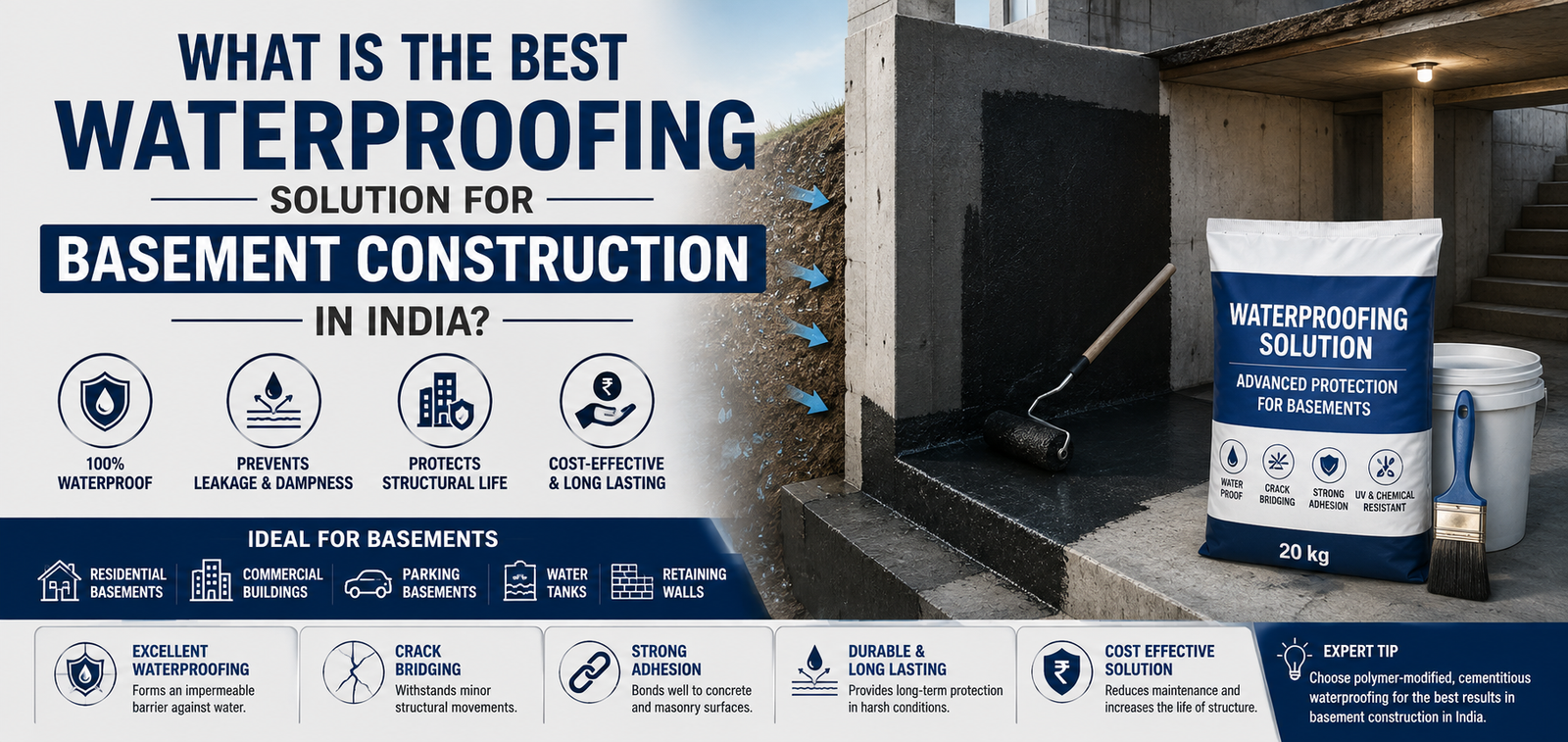
What Is the Best Waterproofing Solution for Basement Construction in India?

What Is the Best Waterproofing Solution for Basement Construction in India

Basements in Indian buildings face constant pressure from groundwater, monsoon seepage, and rising damp. Choosing the wrong waterproofing method can cost lakhs in repairs later.

This guide breaks down the best waterproofing solutions for basement construction in India, based on soil type, water table, and structural design.

Quick Answer

For most Indian basements, crystalline waterproofing combined with a bentonite or HDPE membrane offers the best long-term protection. Crystalline compounds penetrate concrete and seal capillary pores from within.

Membranes handle external hydrostatic pressure. Together, they protect RCC (Reinforced Cement Concrete) basements from both internal moisture and external groundwater ingress, especially in high water table zones like Mumbai, Kolkata, and coastal Kerala.

Why Basement Waterproofing Needs Special Attention

Basements sit below ground level, so they face hydrostatic pressure from all sides. Unlike terraces or bathrooms, water pushes inward constantly, not just during rain.

Common problems in poorly waterproofed basements include:

  • Efflorescence (white salt deposits) on walls
  • Dampness leading to mold and fungal growth
  • Corrosion of reinforcement steel inside RCC
  • Cracks from water pressure and soil movement
  • Reduced structural life of the foundation

In coastal and high-rainfall regions, the water table often rises close to the basement slab. This makes waterproofing a structural necessity, not a cosmetic add-on.

Best Waterproofing Methods for Indian Basements

Here is a comparison of methods commonly used in India, based on application and performance.

Method Best For Key Advantage Limitation
Crystalline Waterproofing New RCC basements Self-heals hairline cracks Needs correct dosage in concrete mix
Bentonite Waterproofing High water table sites Swells on contact with water Requires confinement pressure
HDPE Membrane External basement walls Strong physical water barrier Needs skilled installation
Polyurethane (PU) Injection Grouting Existing leakage repair Fast, targeted crack sealing Not a standalone primary system
Cementitious Coating Internal wet walls Easy to apply, cost-effective Rigid, can crack under movement

Most engineers recommend combining two systems rather than relying on one. A membrane stops external water. A crystalline additive protects the concrete matrix itself.

Crystalline Waterproofing: How It Works

Crystalline waterproofing compounds are added to the concrete mix or applied as a slurry coat on the surface. They react with moisture inside the concrete.

This reaction forms insoluble crystals that block capillary tracts. Even years later, if new cracks form, moisture reactivates the crystals and reseals the gap.

This self-healing property makes crystalline systems ideal for basements, where re-excavation for repair is expensive and disruptive.

Membrane Waterproofing: External Protection

Membranes are applied to the outer face of the basement wall before backfilling. Bentonite panels and HDPE sheets are the two most common choices in India.

Bentonite clay swells when it contacts water, sealing gaps automatically. HDPE membranes act as a physical shield and work well in sites with chemical or saline groundwater.

Factors That Decide the Right Solution

Choosing between systems depends on several site-specific factors. Consider these before finalizing a waterproofing plan:

Water table level: High water table areas need combined membrane and crystalline systems.

Soil type: Clayey or expansive soils demand flexible waterproofing solutions.

Construction stage: New builds allow admixture-based crystalline waterproofing from the start.

Budget and timeline: Membranes need more labor time but offer stronger long-term protection.

Basement usage: Parking basements tolerate minor dampness; storage or residential basements cannot.

Common Mistakes in Basement Waterproofing

Many contractors in India still treat waterproofing as an afterthought. This leads to avoidable and costly failures.

  • Applying waterproofing only after leakage appears
  • Skipping proper surface preparation before membrane installation
  • Using a single-layer system in high water table zones
  • Ignoring construction joints, which are the most common leak points
  • Not curing crystalline coatings for the recommended period

Final Thoughts

There is no single universal answer to basement waterproofing in India. The best solution depends on soil, water table, and building design.

For most residential and commercial basements, a layered approach works best. Combine crystalline waterproofing in the concrete with an external membrane system for maximum protection.

Frequently Asked Questions

  1. What is the best waterproofing method for basements in India?

Crystalline waterproofing combined with an external membrane, such as bentonite or HDPE, is the most reliable method for Indian basements, since it addresses both internal concrete porosity and external groundwater pressure together.

  1. Can waterproofing be done after a basement is already leaking?

Yes, existing leaks can be repaired using polyurethane injection grouting, which seals active water paths by injecting expanding foam directly into cracks. However, this is a repair method, not a substitute for proper waterproofing done during construction.

  1. How long does crystalline waterproofing last in a basement?

Crystalline waterproofing lasts the lifetime of the concrete structure because the crystals form permanently within the concrete and reactivate whenever new moisture reaches a crack, offering continuous self-sealing protection.

  1. Is basement waterproofing necessary in low-rainfall areas of India?

Yes, basements need waterproofing even in low-rainfall regions, because groundwater and soil moisture affect the structure year-round, not just during monsoon months, and hydrostatic pressure exists regardless of surface rainfall.

  1. What causes basement waterproofing to fail after installation?

Basement waterproofing usually fails due to poor surface preparation, skipped construction joint treatment, or using a single waterproofing layer in high water table zones. Correct installation and combining two complementary systems prevents most failures.

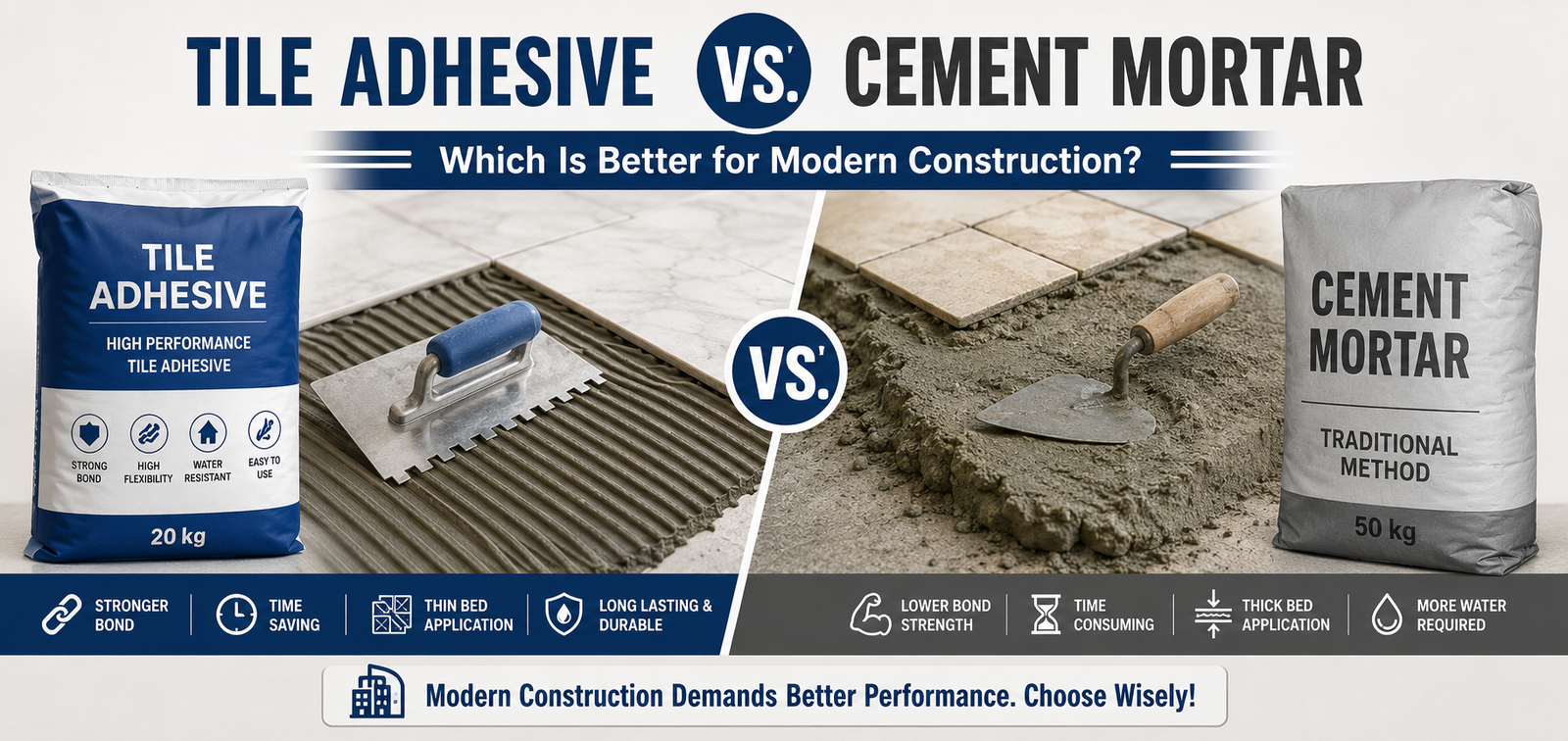
Tile Adhesive vs. Cement Mortar: Which Is Better for Modern Construction?

Tile Adhesive vs. Cement Mortar Which Is Better for Modern Construction

The type of tile adhesive or cement mortar you use will determine how long your tiles stay in place. The wrong choice often leads to hollow sounds, cracked tiles, or costly rework.

This blog compares tile adhesive and cement mortar across performance, cost, and suitability for modern tile types like vitrified and large-format tiles.

Quick Answer

Tile adhesive is better than cement mortar for modern construction, especially for vitrified tiles, large-format tiles, and wall applications. It offers stronger bonding, faster curing, and better resistance to moisture.

Cement mortar still works for traditional ceramic tiles on floors in budget projects, but it struggles with today’s low-porosity, heavy-format tiles.

What Is Cement Mortar Tile Fixing?

Cement mortar fixing is the traditional method used across India for decades. It involves mixing cement, sand, and water to form a thick bed under the tile.

This method relies on mechanical keying, meaning the mortar physically grips the rough back of the tile. It works reasonably well with older, porous ceramic tiles.

What Is Tile Adhesive?

Tile adhesive is a factory-manufactured, polymer-modified cementitious product. It is mixed with water on-site and applied in a thin, even layer using a notched trowel.

Polymers in the adhesive create a strong chemical and mechanical bond. This is essential for modern vitrified tiles, which have almost no surface porosity for mortar to grip.

Tile Adhesive vs. Cement Mortar: Side-by-Side Comparison

Parameter Tile Adhesive Cement Mortar
Bond Strength High, chemical + mechanical bond Moderate, mechanical bond only
Best Suited For Vitrified, porcelain, large-format tiles Ceramic tiles, ordinary ceramic surfaces
Layer Thickness Thin bed (3-6 mm) Thick bed (12-20 mm)
Water/Moisture Resistance High, suitable for wet areas Low, prone to moisture damage
Curing Time Faster, ready in 24-48 hours Slower, needs longer curing
Weight on Structure Lighter, reduces dead load Heavier, adds to structural load
Cost Higher material cost Lower material cost
Skill Required Moderate, needs proper trowel technique Lower, but skill-dependent, finish
Shrinkage & Cracking Minimal, due to polymer flexibility Higher risk over time

Why Modern Tiles Need Tile Adhesive

Vitrified and porcelain tiles are manufactured with very low water absorption, often under 0.5%. This makes them dense and largely non-porous by design.

Cement mortar depends on porosity for grip. Without it, mortar cannot form a durable bond, which often leads to hollow tiles and eventual debonding.

Tile adhesive solves this issue through polymer additives that chemically bond to both the substrate and the tile back, regardless of tile porosity.

When Cement Mortar Still Makes Sense

Cement mortar is not obsolete. It remains a practical choice in specific situations, particularly in cost-sensitive or traditional projects.

  • Fixing standard ceramic floor tiles in dry, low-traffic areas
  • Budget residential projects with limited material costs
  • Areas where thick leveling beds are needed for uneven substrates
  • Projects using smaller, porous tiles with rough backing

Key Advantages of Tile Adhesive for Modern Construction

Modern construction increasingly favors tile adhesive due to several practical and technical benefits over conventional mortar systems.

  1. Stronger bonding: Polymer modification creates flexible, high-strength adhesion.
  2. Thinner application: Reduces added load on floors and walls.
  3. Better for wet areas: Performs well in bathrooms, kitchens, and balconies.
  4. Faster project timelines: Shorter curing means quicker handover.
  5. Suitable for wall cladding: Cement mortar cannot reliably hold tiles on vertical walls.

Understanding C1 and C2 Grade Adhesives

Tile adhesives are classified under standards like EN 12004, commonly referenced in India as C1 and C2 grades.

C1 adhesives suit standard ceramic tiles in normal conditions. C2 adhesives, which include polymer-modified variants, are designed for vitrified, porcelain, and large-format tiles under demanding conditions.

Final Verdict

For modern construction, tile adhesive is the better choice overall. It handles today’s dense, large-format tiles far more reliably than cement mortar ever could.

Cement mortar still has a place in low-budget, traditional ceramic tile work. But for durability, speed, and long-term performance, tile adhesive is the smarter investment.

Frequently Asked Questions

  1. Is tile adhesive better than cement mortar for vitrified tiles?

Yes, tile adhesive is significantly better for vitrified tiles because their low porosity prevents cement mortar from forming a strong mechanical bond, while adhesive uses polymer chemistry to bond regardless of tile porosity.

  1. Can cement mortar be used for wall tiles?

Cement mortar is not recommended for wall tiles, since its weight and lack of chemical bonding make tiles prone to sagging or falling off vertical surfaces. Tile adhesive is the standard choice for walls.

  1. Why does tile adhesive cost more than cement mortar?

Tile adhesive costs more because it is a factory-engineered product with added polymers, fillers, and additives that improve bonding, flexibility, and water resistance, unlike basic on-site cement and sand mixtures.

  1. How thick should a tile adhesive layer be?

A tile adhesive layer is typically applied at 3 to 6 millimeters using a notched trowel, which is much thinner than the 12 to 20 millimeter bed usually required for cement mortar fixing.

  1. Does tile adhesive work in bathrooms and wet areas?

Yes, tile adhesive is well suited to bathrooms and wet areas because its polymer content resists moisture penetration far better than cement mortar, reducing the risk of tile debonding over time.

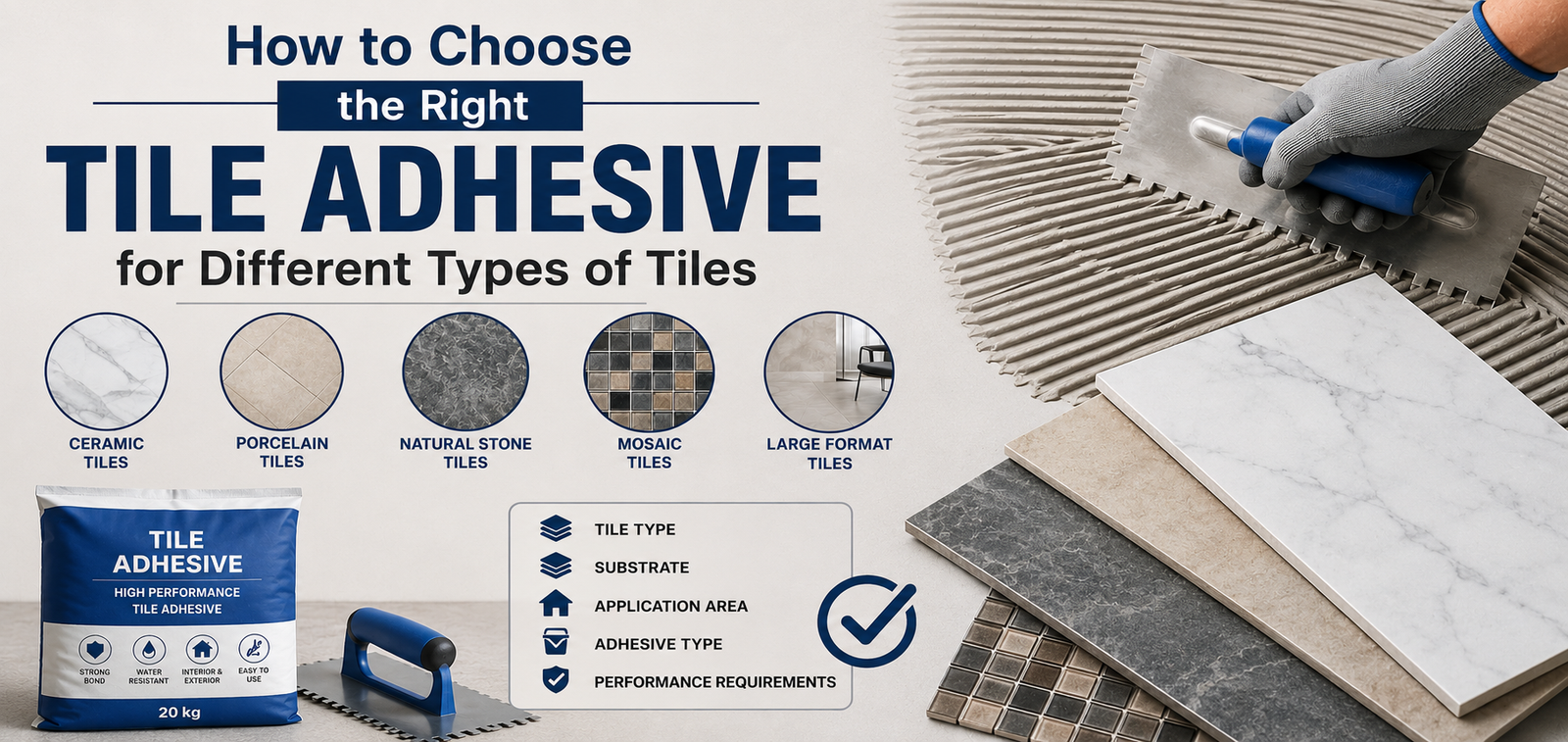
How to Choose the Right Tile Adhesive for Different Types of Tiles

How to Choose the Right Tile Adhesive for Different Types of Tiles

Choosing the right tile adhesive can feel confusing. There are so many types on the market today.

But picking the wrong one can cause tiles to crack, pop up, or fall off later. This guide makes it simple. By the end, you will know exactly which tile fixing adhesive works best for your project in India.

Quick Answer

The right tile adhesive depends on your tile type, surface, and location. Cement-based adhesives work for ceramic tiles on normal floors. Polymer-modified adhesives suit large-format and vitrified tiles. Epoxy-based adhesives are best for wet areas like bathrooms, pools, and outdoor spaces in India’s heat. Always match the adhesive to the tile’s weight, size, and water exposure.

Why Tile Adhesive Selection Matters So Much

Tiles are heavy. They need strong support to stay fixed on a wall or floor for years.

A weak or wrong adhesive cannot hold this weight properly. This phenomenon is called adhesive failure.

In India, high heat and humidity make this problem worse. The wrong glue can weaken faster in hot weather.

Good tile adhesive stops tiles from moving, cracking, or lifting. It keeps your floor safe and strong.

Types of Tiles and the Adhesive They Need

Different tiles have different needs. Let’s break this down simply.

1. Ceramic Tiles

Ceramic tiles are light and common in homes. They are used in kitchens and living rooms often.

A standard cement-based tile adhesive works well here. It gives strong grip at a low cost.

2. Vitrified Tiles

Vitrified tiles are heavier and less porous than ceramic ones. They absorb very little water.

This means normal adhesive may not stick well. You need a polymer-modified adhesive for a stronger bond.

3. Natural Stone Tiles

Marble, granite, and sandstone fall under natural stone. These stones can stain easily.

Use a white cement-based adhesive with low moisture content. This prevents staining and discoloration.

4. Large-Format Tiles

Large tiles are trending in modern India homes. They look elegant but are harder to fix.

These tiles need high-bond-strength adhesive. It must resist sagging and slipping during installation.

5. Glass and Mosaic Tiles

Glass tiles are delicate and often used in pools or decorative walls. They need a flexible adhesive.

This flexible bond adjusts to small movements without cracking the glass.

Adhesive Guide Table

Here is a simple table to help you choose faster.

Tile Type Best Adhesive Type Common Use Area
Ceramic Tiles Cement-based adhesive Kitchen, living room
Vitrified Tiles Polymer-modified adhesive Living room, flooring
Natural Stone White cement adhesive Lobby, staircases
Large Format Tiles High-bond adhesive Modern interiors
Glass or Mosaic Tiles Flexible adhesive Pools, bathrooms, decor walls
Outdoor or Wet Areas Epoxy-based adhesive Terrace, bathroom, pool deck

Why India’s Climate Changes Your Adhesive Choice

India has very high heat for most of the year. This affects how tile adhesive performs.

Standard adhesives can dry too fast in strong sun. This condition weakens the bond over time.

For outdoor tiling, always choose heat-resistant tile adhesive. It handles temperature changes better.

For wet areas like bathrooms and pools, pick waterproof tile adhesive. It resists moisture damage fully.

Simple Steps to Pick the Right Adhesive

Follow these easy steps before buying any adhesive.

  • Check your tile type first: Ceramic, vitrified, stone, or glass
  • Check the tile size and weight carefully
  • Check if the area is wet, dry, indoor, or outdoor
  • Check India’s weather exposure for outdoor tiling
  • Always choose branded, tested construction chemicals

These small checks save you from costly repair work later.

Common Mistakes to Avoid

Many people make the same tiling mistakes. Avoid these simple errors.

  • Using ceramic adhesive for heavy vitrified tiles
  • Skipping waterproof adhesive in bathrooms
  • Ignoring surface preparation before tiling
  • Buying cheap, unbranded adhesive products

Good preparation and the right product prevent most tiling problems.

Why Surface Preparation Also Matters

Adhesive alone cannot fix a weak surface. The base surface must be clean and level first.

Dust, oil, or cracks weaken adhesive grip badly. Always clean and level the surface before tiling starts.

This step works together with the right adhesive. Both are equally important for long-lasting tiles.

Need the right tile adhesive for your India project? CretePro Trading supplies trusted construction chemicals, adhesives, grouts, and waterproofing solutions from leading global brands.

Get expert guidance and quality materials, delivered on time, every time. Contact CretePro Trading today for a free consultation.

Frequently Asked Questions

  1. What is the best tile adhesive for bathroom tiles in India?

Epoxy-based or waterproof tile adhesive works best for bathrooms. It resists constant moisture and prevents tiles from loosening over time.

  1. Can I use the same adhesive for floor and wall tiles?

No, wall tiles need lighter, quick-grip adhesive. Floor tiles need stronger, heavy-duty adhesive to support foot traffic and weight.

  1. Why do tiles pop up after some months in India?

This usually happens due to wrong adhesive choice, poor surface prep, or heat expansion. Using proper polymer-modified or heat-resistant adhesive prevents this issue.