

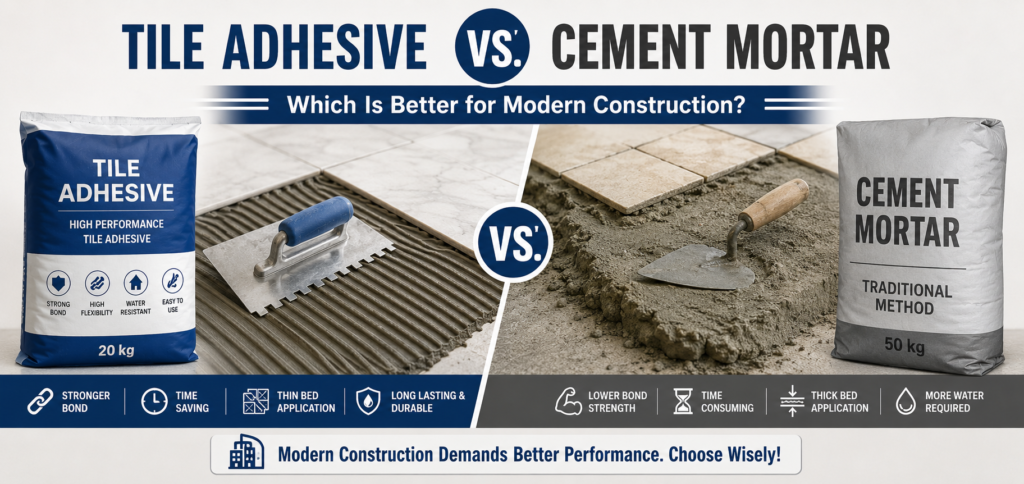
The type of tile adhesive or cement mortar you use will determine how long your tiles stay in place. The wrong choice often leads to hollow sounds, cracked tiles, or costly rework.
This blog compares tile adhesive and cement mortar across performance, cost, and suitability for modern tile types like vitrified and large-format tiles.
Quick Answer
Tile adhesive is better than cement mortar for modern construction, especially for vitrified tiles, large-format tiles, and wall applications. It offers stronger bonding, faster curing, and better resistance to moisture.
Cement mortar still works for traditional ceramic tiles on floors in budget projects, but it struggles with today’s low-porosity, heavy-format tiles.
What Is Cement Mortar Tile Fixing?
Cement mortar fixing is the traditional method used across India for decades. It involves mixing cement, sand, and water to form a thick bed under the tile.
This method relies on mechanical keying, meaning the mortar physically grips the rough back of the tile. It works reasonably well with older, porous ceramic tiles.
What Is Tile Adhesive?
Tile adhesive is a factory-manufactured, polymer-modified cementitious product. It is mixed with water on-site and applied in a thin, even layer using a notched trowel.
Polymers in the adhesive create a strong chemical and mechanical bond. This is essential for modern vitrified tiles, which have almost no surface porosity for mortar to grip.
Tile Adhesive vs. Cement Mortar: Side-by-Side Comparison
| Parameter | Tile Adhesive | Cement Mortar |
| Bond Strength | High, chemical + mechanical bond | Moderate, mechanical bond only |
| Best Suited For | Vitrified, porcelain, large-format tiles | Ceramic tiles, ordinary ceramic surfaces |
| Layer Thickness | Thin bed (3-6 mm) | Thick bed (12-20 mm) |
| Water/Moisture Resistance | High, suitable for wet areas | Low, prone to moisture damage |
| Curing Time | Faster, ready in 24-48 hours | Slower, needs longer curing |
| Weight on Structure | Lighter, reduces dead load | Heavier, adds to structural load |
| Cost | Higher material cost | Lower material cost |
| Skill Required | Moderate, needs proper trowel technique | Lower, but skill-dependent, finish |
| Shrinkage & Cracking | Minimal, due to polymer flexibility | Higher risk over time |
Why Modern Tiles Need Tile Adhesive
Vitrified and porcelain tiles are manufactured with very low water absorption, often under 0.5%. This makes them dense and largely non-porous by design.
Cement mortar depends on porosity for grip. Without it, mortar cannot form a durable bond, which often leads to hollow tiles and eventual debonding.
Tile adhesive solves this issue through polymer additives that chemically bond to both the substrate and the tile back, regardless of tile porosity.
When Cement Mortar Still Makes Sense
Cement mortar is not obsolete. It remains a practical choice in specific situations, particularly in cost-sensitive or traditional projects.
- Fixing standard ceramic floor tiles in dry, low-traffic areas
- Budget residential projects with limited material costs
- Areas where thick leveling beds are needed for uneven substrates
- Projects using smaller, porous tiles with rough backing
Key Advantages of Tile Adhesive for Modern Construction
Modern construction increasingly favors tile adhesive due to several practical and technical benefits over conventional mortar systems.
- Stronger bonding: Polymer modification creates flexible, high-strength adhesion.
- Thinner application: Reduces added load on floors and walls.
- Better for wet areas: Performs well in bathrooms, kitchens, and balconies.
- Faster project timelines: Shorter curing means quicker handover.
- Suitable for wall cladding: Cement mortar cannot reliably hold tiles on vertical walls.
Understanding C1 and C2 Grade Adhesives
Tile adhesives are classified under standards like EN 12004, commonly referenced in India as C1 and C2 grades.
C1 adhesives suit standard ceramic tiles in normal conditions. C2 adhesives, which include polymer-modified variants, are designed for vitrified, porcelain, and large-format tiles under demanding conditions.
Final Verdict
For modern construction, tile adhesive is the better choice overall. It handles today’s dense, large-format tiles far more reliably than cement mortar ever could.
Cement mortar still has a place in low-budget, traditional ceramic tile work. But for durability, speed, and long-term performance, tile adhesive is the smarter investment.
Frequently Asked Questions
- Is tile adhesive better than cement mortar for vitrified tiles?
Yes, tile adhesive is significantly better for vitrified tiles because their low porosity prevents cement mortar from forming a strong mechanical bond, while adhesive uses polymer chemistry to bond regardless of tile porosity.
- Can cement mortar be used for wall tiles?
Cement mortar is not recommended for wall tiles, since its weight and lack of chemical bonding make tiles prone to sagging or falling off vertical surfaces. Tile adhesive is the standard choice for walls.
- Why does tile adhesive cost more than cement mortar?
Tile adhesive costs more because it is a factory-engineered product with added polymers, fillers, and additives that improve bonding, flexibility, and water resistance, unlike basic on-site cement and sand mixtures.
- How thick should a tile adhesive layer be?
A tile adhesive layer is typically applied at 3 to 6 millimeters using a notched trowel, which is much thinner than the 12 to 20 millimeter bed usually required for cement mortar fixing.
- Does tile adhesive work in bathrooms and wet areas?
Yes, tile adhesive is well suited to bathrooms and wet areas because its polymer content resists moisture penetration far better than cement mortar, reducing the risk of tile debonding over time.